Choosing the right bike speedometer and odometer can improve training, route planning, and safety. The best models deliver accurate current, max, and average speed, total distance, and trip distance, plus elapsed time, pace, and clock. Practical features such as auto start/stop, backlight, and weather resistance increase reliability across road, mountain, and gravel bikes. In this guide, five top options—spanning wired and wireless designs—are evaluated for ease of setup, battery life, readability, and durability. Use the Buying Guide to compare GPS versus non-GPS, mounting options, and data tracking needs for your cycling style.
| Product | Brand | Key Features |
|---|---|---|
| CATEYE Velo Wired Entry-Level | CATEYE | Current/ max / average speed; total & trip distance; elapsed time; pace; clock; auto start/stop; wired sensor; long battery life |
| CYCPLUS GPS Bike Computer | CYCPLUS | Dynamic GPS positioning; ride time & distance; altitude; automatic backlight; IPX6; 1200 mAh battery; 55+ hours |
| CATEYE Urban Wireless Bike Computer | CATEYE | Current/ max / average speed; total distance; calories; programmable odometer; FlexTight mounting |
| Bikevee GPS Bike Computer | Bikevee | GPS altitude; 2.4″ LCD; IPX7; 28 hours; 5-satellite system; auto start/stop; backlight |
| Hilceriy Wired Bike Computer | Hilceriy | Speed, average, max; KM/h; backlight; IPX6; calories & temperature; wired stability |
CATEYE Velo Wired Entry-Level Speedometer

The Velo Wired offers essential data with a simple setup. It displays current, max, and average speed, total distance, trip distance, elapsed time, pace arrow, and a clock. A wired speed sensor reduces interference, delivering dependable readings across road, mountain, and gravel bikes. Designed for reliability, it supports straightforward installation and a compact form factor suitable for riders who prefer a no-fuss device on their handlebars.
Key features include auto start/stop that stops counting time and averaging speed when stopped, preventing skewed training data. The unit is designed for easy setup and compatibility with multiple bike types, making it a solid entry point for beginners or riders who value clarity over complexity. The model is backed by a long-lasting battery cycle, reducing the need for frequent maintenance.
- Wired sensor for accurate measurements
- Displays current/max/average speed, total and trip distance, elapsed time, pace, and clock
- Auto Start/Stop; easy installation; 3-year battery life
CYCPLUS GPS Bike Computer

The CYCPLUS GPS Bike Computer emphasizes precise GPS data and route analysis for riders who want to map training and explore new roads. Its higher-sensitivity GPS positioning tracks your route and provides ride time, riding distance, total riding time, total riding mileage, a clock, and current altitude. The device supports an automatic backlight with FSTN technology, ensuring clear readings in bright sunlight or dim conditions, while tempered glass protects the display from scratches.
Water resistance is rated IPX6, and the 1200 mAh battery delivers more than 55 hours of operation, reducing the need for frequent recharging on long rides. The wireless setup helps keep handlebars uncluttered, and the device’s rugged construction makes it suitable for varied weather and terrain. This model suits cyclists who prize GPS-driven analytics and route planning alongside dependable everyday measurements.
- Dynamic GPS positioning with high sensitivity
- Automatic backlight; readable in sun or shade
- IPX6 waterproof; 1200 mAh battery for 55+ hours
CATEYE Urban Wireless Bike Computer

The Urban Wireless model blends classic odometer readouts with modern capabilities. It displays current, max, and average speed, total distance, trip distance, elapsed time, calories, a pace arrow, and a clock. A notable advantage is the option to manually set the odometer, which avoids losing mileage when the battery is replaced, preserving long-term data continuity for regular riders or competitive cyclists.
FlexTight Bracket design enables quick, tool-free mounting and easy repositioning, making the device adaptable to different frame styles and rider preferences. The combination of readable displays and flexible mounting positions makes this unit well suited for riders who want straightforward data tracking without extra features getting in the way of training.
- All essential stats with calories and pace
- Programmable odometer; manual mileage adjustment
- FlexTight Bracket for secure, adjustable mounting
Bikevee GPS Bike Computer
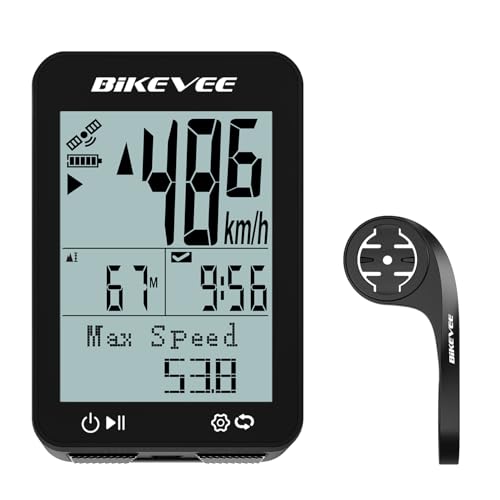
The Bikevee GPS Bike Computer is a wireless device designed for riders who want comprehensive data with a long battery life. It provides GPS altitude, a clock, speed in MPH and KM/H, trip time, trip distance, total time, total distance, average speed, max speed, and a backlight in a single 2.4-inch LCD display. Its IPX7 waterproofing ensures performance in wet conditions, while a 5-satellite system (GPS, BDS, GLONASS, Galileo, QZSS) supports stable data collection even in challenging environments.
With a 650 mAh battery, this model can sustain up to 28 hours of continuous use, making it well suited for multi-day rides or weekend trips where charging opportunities are limited. The combination of GPS accuracy, robust weather resistance, and clear visualization supports riders who rely on precise metrics for performance analysis and training planning.
- GPS altitude data and multi-satellite tracking
- 2.4″ LCD display with backlight; IPX7
- Up to 28 hours of operation on a single charge
Hilceriy Wired Bike Computer

The Hilceriy Wired Bike Computer emphasizes multi-function data in a reliable wired setup. It measures speed average, maximum speed, and KM/h, along with riding time and distance. The device also tracks calories statistics and temperature, expanding the scope of training data for fitness-focused cyclists. Its compact, portable design ensures it fits on a wide range of handlebars and frame styles.
Readability is supported by a backlit display for day and night use, and the IPX6 rating provides resilience against rain and moisture. The wired connection minimizes signal interference, delivering steady, consistent readings across most riding conditions. This model suits riders who want a budget-friendly option with broader metrics, including environmental data like temperature.
- Multi-function metrics: speed, time, distance, calories, temperature
- Backlit display; IPX6 rated for weather resistance
- Wired setup for steady readings
Buying Guide
Key purchase considerations
- Wired vs wireless: Wired devices tend to offer very stable readings with fewer interference issues, but require more careful mounting of the sensor. Wireless units reduce cable clutter but rely on battery life and radio signals, which can affect reliability in dense urban environments or under heavy signal loss.
- GPS vs non-GPS: GPS-enabled computers provide route data, altitude, and more comprehensive analytics, ideal for training and mapping. Non-GPS models rely on wheel speed sensors and can be simpler and less expensive, suitable for casual riders who mainly want speed and distance.
- Display size and readability: A larger, high-contrast display improves legibility on the move, especially in bright sun or during night rides. Backlighting is a key feature for early morning or late-evening sessions.
- Battery life: For wireless devices, battery life determines how often you must recharge. Longer life is essential for multi-day trips or long training blocks without frequent charging.
- Water resistance and durability: IP ratings indicate resilience to rain and splashes. Choose a device that can withstand your typical weather conditions and riding environment.
- Mounting and compatibility: Check handlebar diameter compatibility and whether the bracket supports easy adjustment or removal. Some models offer tool-free mounting for quick transfers between bikes.
- Odometer options: Some units allow programmable odometers or manual mileage adjustments after battery changes, preserving data continuity over time.
- Auto start/stop and auto backlight: These features simplify logging by automatically recording rides and maintaining readability without manual input during the ride.
- Data export and ecosystem: Consider whether the device offers data export or integration with apps and platforms you already use for training and tracking.
Use-case recommendations
- Road cyclists: Prioritize lightweight wireless GPS models with long battery life and clear screens. GPS altitude and route data are especially valuable for performance tracking.
- Mountain biking: Look for IPX7 or higher water resistance, rugged durability, and large displays that remain legible in rough conditions. A stable sensor arrangement helps with accurate readings on rough trails.
- Commuters and casual riders: Simpler wired or wireless models with easy installation, essential metrics, and automatic features (start/stop, backlight) provide reliable data without complexity.
Data accuracy and reliability considerations
Accuracy depends on sensor quality, GPS reception, and proper mounting. Wired systems reduce interference, improving consistent readings in areas with electronic noise. GPS-based devices excel for route and altitude data but can be influenced by tunnel or urban canyon effects, though modern receivers compensate well. Backlight and display readability influence how quickly you can read data mid-ride, which matters for safety and quick decision-making. Battery life and weather resistance directly affect uptime during longer rides or adverse conditions.