Maximizing garage space is essential for cyclists who want quick access to their bikes without clutter. A vertical bike rack keeps bikes upright, frees floor space, and protects wheels from contact. The following five options blend solid steel construction, reliable swivels, and easy installation to suit apartments, garages, and sheds. The table summarizes key specs for quick comparison.
| Product | Brand | Type | Weight / Capacity |
|---|---|---|---|
| monTEK Swivel Wall Mount 4 Pack | monTEK | Wall-mounted Vertical Rack | 66 lbs per unit |
| monTEK Swivel Wall Mount 2 Pack | monTEK | Wall-mounted Vertical Rack | 66 lbs per unit |
| Steadyrack Vertical Wall Rack | Steadyrack | Wall-mounted Pivot Rack | Fits tires up to 2.1″; wheels 20″–29″ |
| Ultrawall Freestanding Vertical Rack | Ultrawall | Freestanding Vertical Rack | Up to 4 bikes; 100 lbs per hook |
| Delta Michelangelo 2 Bike Gravity Stand | Delta Cycle & Home | Gravity Stand (No Mount) | Up to 80 lbs total |
monTEK Swivel Wall Mount, 4 Pack

This heavy-duty steel wall mount is designed for strong, secure vertical storage. Each hanger supports up to 66.2 lbs, with a rubber-coated contact surface to protect wheels, rims, and spokes from scratches. The system enables vertical storage for easy access and removal. An upgraded 150° swivel bearing system allows center, left, or right angled positions, enabling storage flush against a wall and clear space around parked vehicles or in tight apartments. It’s compatible with most bikes, including road, MTB, cruisers, BMX, and fenders, though it isn’t suitable for wheels with tires and rims deeper than about 3.54 inches.
monTEK Swivel Wall Mount, 2 Pack

This two-pack version mirrors the same construction and features as the four-pack model: heavy-duty steel construction with a 66.2 lb capacity per hanger, a rubber-coated surface to guard wheels, and a 150° swivel design built on a bearing system. It provides flexible storage around vehicles and in compact living spaces, allowing bikes to sit flush against the wall when rotated into the desired angle. Suitable for a wide range of bikes, including those with fenders, it shares the same depth limitation for wheels and rims as the four-pack.
Steadyrack Vertical Wall Rack

The original pivoting bike rack, Steadyrack revolutionized vertical storage with a simple, space-saving design. Crafted from high-quality steel, it offers dependable vertical storage over years of use. It fits most road, hybrid, and commuter bikes without fenders and supports tires up to 2.1″ wide with wheels ranging from 20″ to 29″. The pivoting mechanism makes loading and unloading straightforward, and its compact profile makes it a staple for garages and narrow hallways alike.
Ultrawall Freestanding Vertical Rack

This freestanding unit offers flexible placement without wall or ceiling mounting. Designed for vertical storage, it can accommodate up to four bikes with four welded hooks rated to 100 lbs each. The steel construction provides durability and stability, making it a practical option for those who want to reorganize a garage without drilling into walls. Its independent footprint is ideal for renters or spaces where wall mounting isn’t feasible.
Delta Michelangelo 2 Bike Gravity Stand
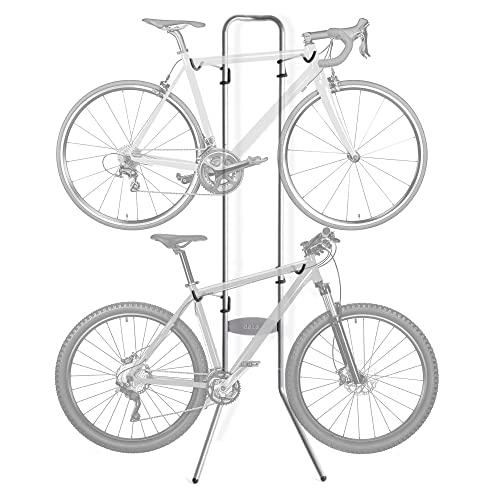
Delta Cycle’s Michelangelo gravity stand suspends bicycles using a wall-lean design with no mounting required. It supports up to 80 lbs total (about 40 lbs per bike) and offers a compact footprint suitable for apartments or garages with limited wall space. The stand relies on a stable base and rubber feet to prevent sliding, combining a stylish finish with practical vertical storage for two bikes in a compact area.
Buying Guide
- Mounting method: Choose wall-mounted racks for a true space-saving solution, freestanding units for renters or walls that can’t be penetrated, or gravity stands for easy, no-installation storage. Each type has distinct installation requirements and space implications.
- Bike and tire compatibility: Check tire width and wheel diameter ranges. Some racks are optimized for tires up to 2.1″ wide and wheels 20″–29″, while others tolerate broader tires or include fenders. Ensure your bikes fit without forcing alignment or risking contact with other bikes or walls.
- Weight capacity: Match rack capacity to the heaviest bike in your collection, plus a margin for future bikes. Wall-mounted racks typically list per-unit limits (e.g., 66 lbs), while freestanding units may specify total or per-hook limits (e.g., 100 lbs per hook).
- Space and layout: Measure available wall height, floor space, and aisle clearance. Wall-mounted options maximize floor space but require sturdy walls and proper installation. Freestanding racks offer placement flexibility but take floor area. Gravity stands vary in footprint and stability.
- Durability and finish: Opt for powder-coated steel or rust-resistant surfaces if your garage is humid or exposed to rain. Rubber-coated contact points protect rims, tires, and frames from scratches.
- Installation effort: Consider your DIY comfort. Some racks require mounting into studs or concrete, while others assemble quickly with minimal tools. For rental spaces, freestanding or gravity options may be preferable.
- Bike access and maintenance: A swivel feature or pivot design can simplify loading and unloading in tight spaces or near vehicles. Regularly check hardware for wear and re-tighten bolts to maintain stability over time.
- Budget and warranty: Higher-capacity, steel-built racks with swivels tend to cost more. Review warranty terms, especially for frequent use or high-traffic garages.
- Future needs: If you anticipate expanding your bike collection, consider modular or multi-pack systems that let you add racks without replacing units.